The Long Way Home
Once you stop measuring a walk by how quickly you get somewhere, a neighborhood begins to look very different.
· September 12, 2026 · 4 min
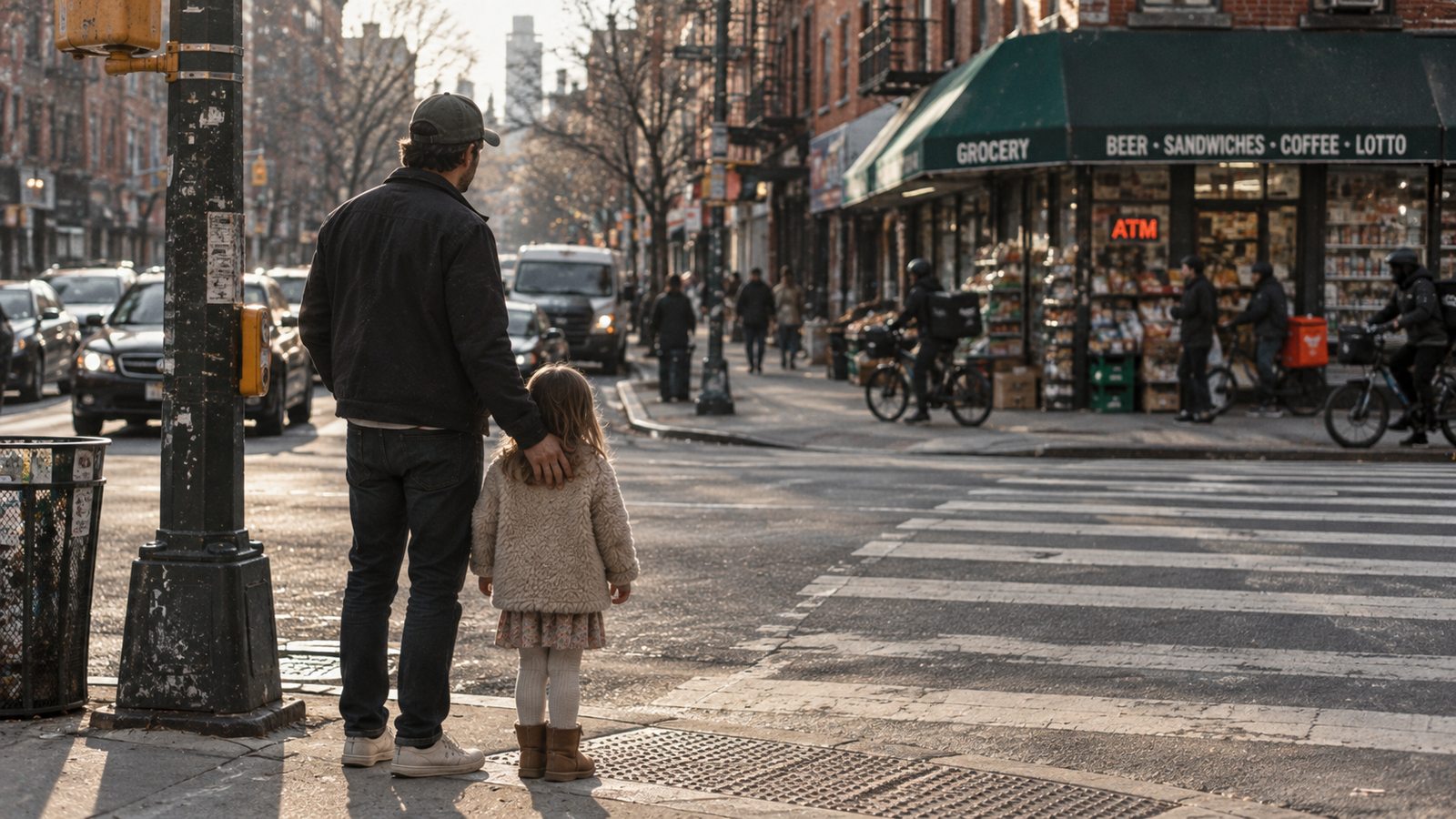
There is a particular kind of walk you take with a small child that would be maddening if you were trying to get anywhere. We live about ten minutes from several places we visit regularly, though ten minutes is an adult measurement, based on continuous forward movement and a general agreement that the purpose of walking is to arrive somewhere else. With my daughter, the same trip can take half an hour.
She stops for dogs. She stops for trucks. She stops at the same construction site we passed yesterday to see whether the excavator, whose progress she follows with the attention some adults reserve for professional sports, is still there. She picks things up that I would prefer she did not pick up. She sometimes turns around and walks in the direction we have just come from, apparently unconcerned by the possibility that this undermines the entire enterprise.
My first instinct is usually to move things along. Come on. This way. Keep walking. We’re going to get coffee. I say these things as though coffee were an appointment for which we might be penalized for arriving late.
This is partly the residue of living in a city. Adults in cities become good at moving through them. We know which subway car leaves us closest to the exit and which side of the escalator is for standing. We can walk while sending an email, listening to something and mentally reorganizing the afternoon. Efficiency becomes so deeply embedded in the experience of getting around that eventually we stop noticing the getting around at all.
A toddler is terrible at this.
She has no interest in the optimal route because she has no concept of an optimal route. The purpose of leaving the apartment is not necessarily to reach the place I have decided we are going. The purpose is whatever happens after we open the door.
This can be inconvenient. There are mornings when we really do need to be somewhere, and no amount of philosophical openness makes a toddler's fascination with a pigeon compatible with an 8:30 appointment. But on the mornings when we don't, I have started trying to notice how often I invent urgency where none exists.
There is a tree on one of our regular routes that my daughter likes to touch. I had passed it hundreds of times before she developed this habit and could not have told you anything about it. Now I know exactly where it is. I know which corner usually has a dog tied outside the coffee shop. I know the stoop where somebody keeps a small ceramic cat. I know which building has the revolving door she wants to use even though we have absolutely no business inside.
None of these things are interesting in the conventional sense. They would not appear in a neighborhood guide. But they have become landmarks in the private geography of our family, places important only because one small person decided they were.
Children do this to a city. They shrink it and enlarge it at the same time. Your radius becomes smaller because everything is harder to reach, but within that radius you begin to know things differently. Parks are no longer green shapes on a map. You know which playground has the good swings, which café has enough room for a stroller and which restaurant can produce bread quickly enough to prevent an international incident.
More unexpectedly, you begin to recognize people. The man at the coffee shop knows her order, or at least the order she reliably requests and then inconsistently consumes. We see the same parents at the playground. There are dogs we know by name whose owners remain somewhat less familiar. A city that can feel anonymous starts becoming a collection of tiny repeated encounters.
I used to think knowing a city meant seeing as much of it as possible. Trying the new restaurant. Walking a neighborhood you hadn't visited. Knowing which exhibition had opened and which place had closed. There is still pleasure in that version of city life, and I hope we keep plenty of it.
But there is another way to know a place, which is to walk the same six blocks so many times that your daughter has opinions about them.
Someday she will move through the city faster. She will stop inspecting every dog. She will learn that a construction site is not generally worth a ten-minute detour. Eventually she may be the one several steps ahead, asking me to hurry up.
For now, when there is nowhere we actually need to be, I am trying to stop telling her to keep moving.
The coffee can wait.
keep reading
The Person You Were Before You Became Dad
Fatherhood changes your life. It doesn't require surrendering the person who had one before it.

The Things She’ll Never Remember
I try not to think about the last time. I think about this time.
Welcome to The Girl Dad
She thinks you're the coolest person alive. Act accordingly.